@Angelina_Kalinichenk
PhrasePump is a great tool for becoming more familiar with the vocabulary you encounter through immersion. It strengthens memory because it demands active recall, not just recognition. That said, PhrasePump has a few weaknesses that could be addressed with relatively small updates.
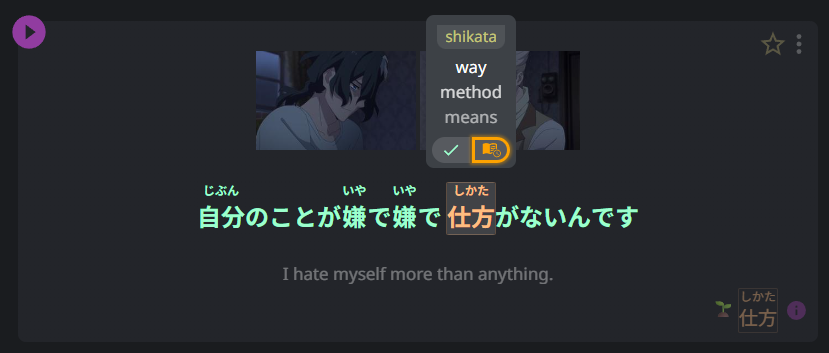
Ubove is an example card from my immersion that illustrates what I think would make PhrasePump more effective.
Right now, the biggest issue is that translation is visible immediately. That becomes an unavoidable crutch for many learners: your eyes naturally jump to what’s familiar, and you end up “confirming meaning” instead of engaging with the target language first.
I’ve already revealed the target word in this example so I can point out something else: the popup dictionary provides three short, one-word definitions. Those definitions would work far better as progressive hints than showing the full translation and/or full sentence context from the start. Even those hints should be hidden initially so the learner gets a clean opportunity to recall. At this point, we do not want transliterations. We must focus on recall.
Proposed workflow for PhrasePump cloze cards
- Start with the sentence clozed (target word hidden).
Keep translation hidden and hints hidden.
- This forces the learner to interact with the target language first.
- It prevents “translation-first scanning,” which undermines recall.
- Reveal the target word next.
This step is especially helpful for Asian languages (or any language with a writing system very different from the learner’s native language).
- It tests reading directly.
- It supports gradual acquisition: you’re not only learning meaning, you’re building visual familiarity with the word’s form.
It may be worth giving the end user some options here. If the target language uses a writing system similar to the learner’s native language, a visual reveal can become too easy and turn into simple recognition rather than recall.
- Reveal hints after that.
Show the short dictionary hints (like the one-word definitions) before the full translation.
- This gives the learner a chance to retrieve meaning with a light prompt instead of jumping straight to the answer.
- It’s a middle step between “no help” and “full solution,” which is ideal for memory formation.
- Reveal the full translation next.
Only after the learner has attempted recall (and possibly used hints) should the full translation appear.
- This provides confirmation and deeper context.
- It also helps resolve ambiguity when a word has multiple senses.
- Play the audio last and integrate everything.
At this point, the learner can connect: spelling/form → meaning → full sentence meaning → pronunciation/intonation.
- This is where the card becomes a “complete rep” that ties together reading, meaning, and sound.
Alternative use case: listening-first mode
If the learner’s main goal is listening, the flow should start with audio first, while keeping everything else the same:
- Play audio first (no text revealed yet).
- Then proceed with the same reveal order: clozed sentence → target word → hints → translation.
This preserves the same core principle (avoid translation-first dependency) while training the ear before the eyes.
Everything can stay the same, with two changes:
- Hide the translation by default so it isn’t visible immediately.
- Add a “Reveal Hint” button (short dictionary-style definitions). Buttons or hover reveal allows the user to choose which feature they want to use in what order.
Audio stays optional and user-controlled, just like it is now.
Also could have an Audio focused mode where everything is blurred, even the target language, very much like PhrasePump’s Practice Mode.
Edit: user notes on a card would also be nice. We could add our own hits, definitions, explinations and things.

